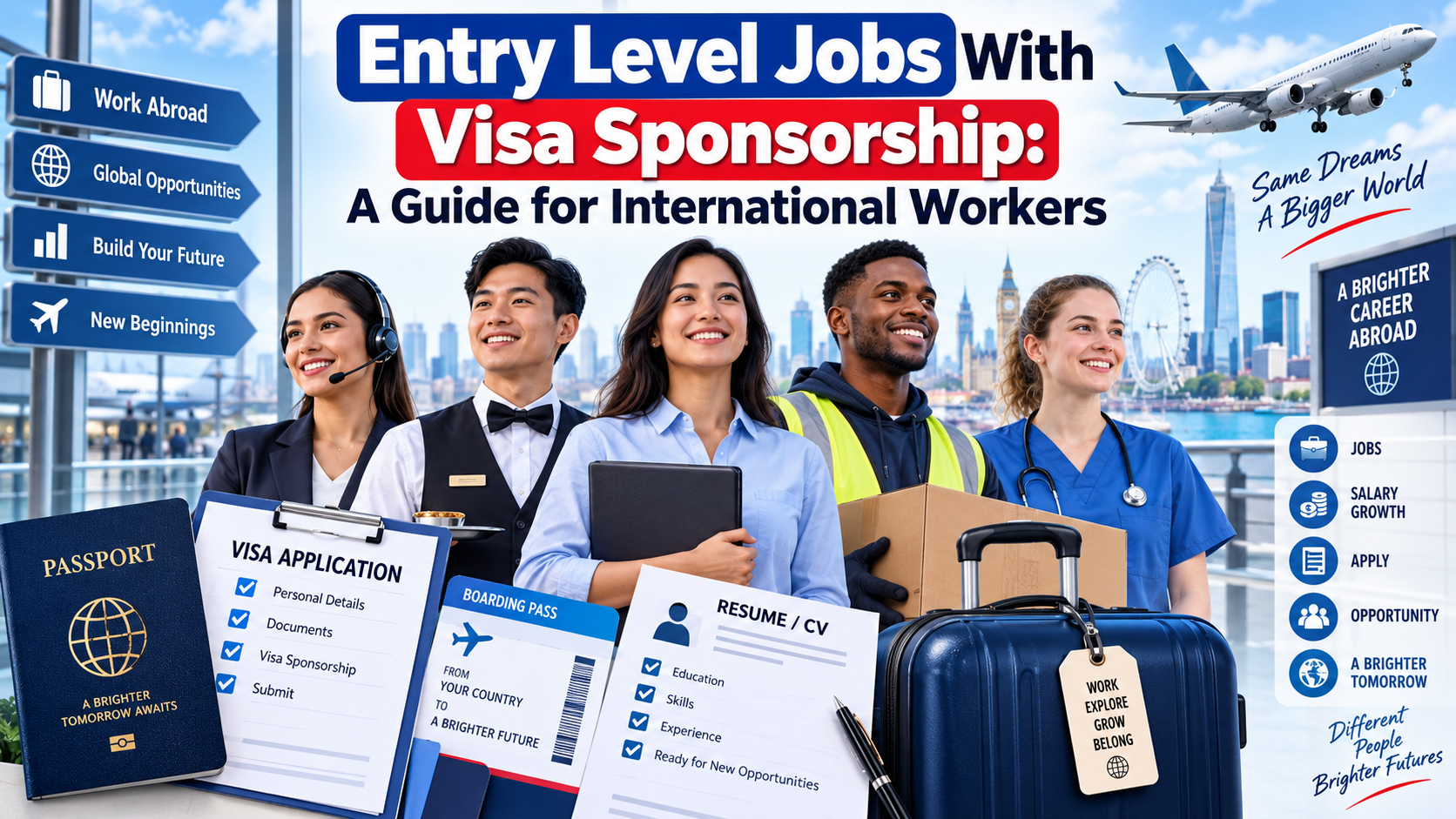
Finding entry level jobs with visa sponsorship can be challenging for international workers who want to begin their careers in the United States. Many employers prefer candidates who already have authorization to work in the country, while some positions may qualify for employer-sponsored employment visas.
The good news is that entry-level opportunities can exist across different industries. However, an important distinction is that a job advertisement saying “visa sponsorship available” does not automatically mean every applicant qualifies for a work visa. The position, candidate’s qualifications, employer, and specific immigration category all matter.
This guide explains what entry-level visa sponsorship means, which types of jobs may be available, how sponsorship generally works, and how international applicants can approach their job search.
What Are Entry Level Jobs With Visa Sponsorship?
Entry level jobs with visa sponsorship are positions that may be available to workers who need an employer to support an immigration or work-authorization process.
An entry-level position usually requires limited professional experience compared with mid-level or senior roles. Some positions may require a college degree, technical training, certifications, or specific skills, while others may focus more heavily on practical abilities.
Visa sponsorship is a separate issue from the job’s experience level.
For example, an entry-level software position could require a bachelor’s degree and potentially fit a specialty-occupation visa category, while another entry-level position may not qualify for that category.
The U.S. Department of State lists several temporary employment visa categories, including H-1B for specialty occupations and H-2A and H-2B for certain temporary or seasonal workers.
Can Entry-Level Jobs Offer Visa Sponsorship?
Yes, some entry-level jobs can potentially be sponsored, but sponsorship is not available for every position.
For an H-1B-type specialty occupation, for example, the Department of State says applicants generally need at least a bachelor’s degree or equivalent experience in the specialty occupation.
This means that an entry-level position can sometimes qualify even though it is considered “entry level.”
The key question is not simply:
“Is this job entry level?”
Instead, applicants need to consider:
- What qualifications does the position require?
- Does the job fit an available visa category?
- Does the employer sponsor foreign workers?
- Does the applicant meet the visa requirements?
- Is an employer petition required?
- Are there numerical or other limitations on the visa category?
Popular Entry-Level Job Categories
International applicants may find sponsorship opportunities in several broad employment areas, although availability changes by employer and immigration category.
1. Entry-Level Technology Jobs
Technology is one area where entry-level candidates may find opportunities requiring specialized education or technical skills.
Potential roles include:
- Junior software developer
- Software engineer
- Data analyst
- IT support specialist
- Junior systems analyst
- Cybersecurity analyst
- Database assistant
- QA tester
Some technology positions may require a bachelor’s degree or equivalent specialized qualifications.
2. Engineering Jobs
Engineering employers may hire recent graduates for positions such as:
- Junior mechanical engineer
- Civil engineering assistant
- Electrical engineering associate
- Manufacturing engineer
- Industrial engineering assistant
- Environmental engineering roles
The specific educational and licensing requirements depend on the position.
3. Healthcare-Related Positions
Healthcare is another large employment sector, but international applicants need to pay particular attention to professional licensing and immigration requirements.
Potential opportunities can include certain administrative, technical, research, and support roles.
Licensed healthcare professions can have additional requirements, including education verification, examinations, licensing, and authorization to practice.
4. Accounting and Finance
Recent graduates may find entry-level positions in:
- Accounting
- Financial analysis
- Audit
- Tax support
- Business analysis
- Financial operations
A degree in accounting, finance, economics, or a related field may be required for some positions.
5. Hospitality and Seasonal Work
Some temporary employment categories can cover certain seasonal positions.
The Department of State identifies the H-2B visa as a category for temporary or seasonal non-agricultural workers, subject to eligibility requirements and limitations.
Hospitality, tourism, and seasonal service industries can therefore be relevant areas for international workers researching temporary employment opportunities.
6. Agricultural Jobs
The H-2A visa is designed for certain temporary or seasonal agricultural workers. Eligibility is subject to specific requirements, including nationality and employment conditions.
This makes agricultural employment another category international workers may encounter when researching U.S. temporary work opportunities.
How Visa Sponsorship Usually Works
A common misconception is that a worker simply applies for a visa after receiving any U.S. job offer.
The process is usually more complicated.
For many temporary worker categories, the prospective employer must file a petition on behalf of the worker. The Department of State explains that most temporary worker visa applicants need an approved petition before applying for the visa.
A simplified process can look like this:
Job search → Job application → Employer selection → Sponsorship/petition process → Petition decision → Visa application, where applicable → Consular processing → Travel and employment
The exact process depends on the visa category.
For example, the employer may need to complete labor-related requirements before submitting a petition. Some categories also have annual numerical limits.
H-1B and Entry-Level Jobs
The H-1B category is particularly relevant to some international graduates and early-career professionals.
It is intended for workers in specialty occupations. According to the Department of State, applicants generally need at least a bachelor’s degree or equivalent experience in the specialty occupation.
Therefore, an entry-level job can potentially be H-1B-related if the position itself qualifies as a specialty occupation and the applicant meets the applicable requirements.
Not every entry-level job qualifies.
For example, simply labeling a position “entry level” or “professional” does not guarantee that it meets H-1B requirements.
Employment-Based Immigrant Options
Temporary work visas are not the only type of employment-related immigration category.
The United States also has employment-based immigrant visa categories.
The Department of State identifies five employment-based preference categories. The third preference, known as EB-3, includes skilled workers, professionals, and certain “other workers” whose jobs require less than two years of training or experience, subject to the applicable requirements.
Some employment-based immigrant categories require an employer to obtain labor certification and file an immigrant petition.
This is different from simply obtaining a temporary work visa.
How to Find Entry Level Jobs With Visa Sponsorship
A focused job-search strategy can make it easier to identify potentially relevant opportunities.
Search by Job Title
Instead of searching only for:
“visa sponsorship jobs”
combine sponsorship terms with specific occupations.
Examples include:
- Entry-level software engineer visa sponsorship
- Junior data analyst visa sponsorship
- Graduate engineering jobs visa sponsorship
- Entry-level accountant visa sponsorship
- International graduate jobs sponsorship
- Entry-level technology jobs sponsorship
This approach can help narrow results to jobs matching your skills.
Research the Employer
Before applying, review the employer’s official careers information and determine whether the company has experience employing international workers.
Look for language such as:
- Visa sponsorship available
- Sponsorship considered
- Immigration sponsorship
- Work authorization sponsorship
- Sponsorship for qualified candidates
However, always read the complete job description because sponsorship policies can vary between positions.
Check the Job Requirements
Pay close attention to:
- Required degree
- Field of study
- Experience
- Certifications
- Technical skills
- Location
- Work authorization
- Sponsorship requirements
A position that looks suitable based on its title may have specific requirements that make it unsuitable for a particular applicant.
How to Improve Your Chances
International applicants can make themselves more competitive by developing skills that employers need.
Build Relevant Skills
Focus on skills directly connected to the jobs you want.
For example, technology candidates may develop programming, data analysis, cloud, or software-development skills.
Business candidates may focus on accounting software, analytics, financial modeling, or business intelligence.
Create a Strong Resume
Your resume should clearly show:
- Education
- Technical skills
- Projects
- Internships
- Work experience
- Certifications
- Relevant achievements
For recent graduates, academic projects and internships can help demonstrate practical ability.
Build a Professional Portfolio
A portfolio can be especially useful for technology, design, writing, data, and other project-based careers.
Show employers what you can actually do rather than listing skills without evidence.
Apply Strategically
Sending hundreds of random applications is usually less effective than targeting employers and positions that match your background.
Prioritize jobs where:
- Your qualifications match the requirements.
- The employer has a history or stated policy of sponsorship.
- The position appears compatible with your intended employment category.
- You can demonstrate relevant skills.
Be Careful With Visa Sponsorship Scams
International job seekers can be attractive targets for employment scams.
Be cautious if someone promises guaranteed U.S. employment or a guaranteed visa in exchange for large upfront payments.
A legitimate employment and immigration process has specific requirements, and an employer or recruiter cannot simply guarantee that a U.S. government agency will approve a visa.
The Department of State also warns that visa approval is not guaranteed simply because an underlying petition has been approved.
Never provide sensitive financial or identity information to an unknown recruiter simply because they claim to offer sponsorship.
What Qualifications Do You Need?
There is no single qualification requirement for all entry-level jobs with visa sponsorship.
Depending on the occupation, employers may look for:
- Bachelor’s degree
- Associate degree
- Technical training
- Professional certification
- Internship experience
- Specialized technical skills
- English communication skills
- Relevant work experience
The immigration requirements are separate from the employer’s normal hiring requirements.
For example, a company may be willing to interview an entry-level applicant, but the applicant may still need to satisfy the requirements of the applicable immigration category.
Frequently Asked Questions
What are entry-level jobs with visa sponsorship?
They are early-career positions where an employer may be willing and able to support an eligible foreign worker’s employment-related immigration process. Sponsorship depends on the job, employer, visa category, and candidate’s qualifications.
Can fresh graduates get jobs with visa sponsorship?
Yes, some fresh graduates can qualify for employer-sponsored opportunities, particularly when their education and skills match positions that can fit an applicable employment category. However, sponsorship is not guaranteed.
Do entry-level jobs qualify for H-1B?
Some can. H-1B is designed for specialty occupations, and applicants generally need at least a bachelor’s degree or equivalent experience in the relevant specialty.
Which industries offer visa sponsorship?
Potential opportunities can exist in technology, engineering, healthcare, finance, agriculture, hospitality, and other sectors. Availability varies considerably by employer and visa category.
Do all companies sponsor international workers?
No. Some companies do not sponsor workers, while others may sponsor only certain positions or candidates.
Does a job offer guarantee a work visa?
No. A job offer does not automatically guarantee visa approval. Depending on the category, the employer may need to file a petition, and the applicant must meet the requirements of the relevant immigration process.
Can someone work in the United States without a work visa?
Foreign nationals generally need appropriate authorization to work in the United States. The correct immigration category depends on the individual’s circumstances and planned employment.
What is the difference between temporary and permanent employment visas?
Temporary employment visas generally authorize qualifying employment for a limited period under specific conditions. Employment-based immigrant visas are intended for permanent immigration and are divided into employment preference categories.
Is visa sponsorship free?
There is no universal “free sponsorship” rule. Different immigration processes can involve employer costs, government fees, legal expenses, and other expenses. Who pays particular costs depends on the visa category and applicable rules.
How can I tell if a job offers sponsorship?
Read the job posting carefully and check the employer’s official careers or recruiting information. If sponsorship information is unclear, the employer’s recruitment team can provide the most accurate information for that specific position.
Conclusion
Finding entry level jobs with visa sponsorship can take more effort than a normal job search because international applicants must consider both employment requirements and immigration requirements.
Technology, engineering, finance, healthcare-related fields, agriculture, hospitality, and other industries can offer opportunities depending on the employer and applicable visa category. However, not every entry-level position qualifies for sponsorship, and receiving a job offer does not automatically guarantee a visa.
The best approach is to identify occupations that match your education and skills, research employers that consider international candidates, carefully review sponsorship language in job descriptions, and verify immigration requirements through official U.S. government sources.
For U.S. temporary employment, the Department of State explains that workers must qualify for the appropriate visa category and that many temporary worker categories require an approved employer petition.
Because immigration rules and procedures can change, applicants should verify current requirements through official government sources or a qualified immigration professional before making important decisions.